The argument so far: Part I of this series considered the software revolution’s transformation of the boundary between organisations and the outside world, while leaving their interiors largely unchanged, and Conway’s Law and stagnant TFP data as the twin expressions of that gap. Part II highlighted that this pattern is nothing new: steam, electricity, and computing all produced their productivity dividends decades after adoption, when organisations finally redesigned themselves around the technology rather than bolting it on. Part II asked whether contemporary organisational leadership could shorten that lag deliberately. This post makes the argument that they can and must.
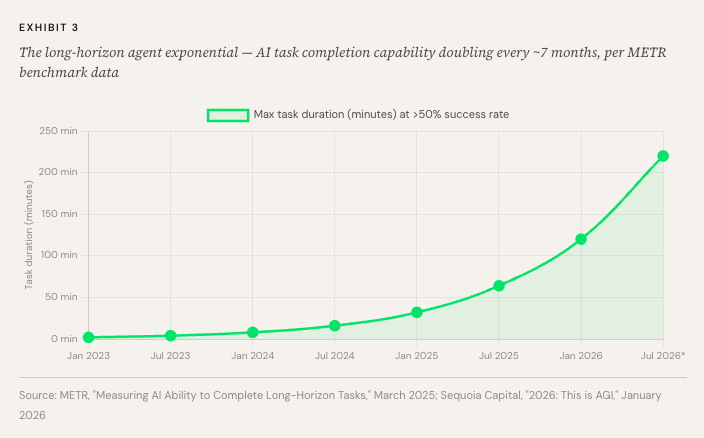
In January 2026, the venture capital firm Sequoia published an essay whose argument deserves to be read alongside Paul David’s 1990 paper on the dynamo. Where David was looking back, explaining why the productivity gains from past technologies had arrived so late, Pat Grady and Sonya Huang were looking forward, making the case that a specific and consequential capability threshold had been crossed. Their argument centres on a progression that matters for anyone interested in organisational design. First came knowledge, the pre-training that made ChatGPT possible in 2022. Then came reasoning, the capacity to think at inference time rather than simply retrieve, which arrived with OpenAI’s o1 in late 2024. The third ingredient, and the most consequential for organisations, is iteration: the ability to take action, encounter an obstacle, adjust, and persist toward a goal without being told what to do next. That third ingredient, they argue, crossed a practical threshold in early 2026.
The talkers-to-doers distinction describes a functional shift that directly determines the organisational implications of the technology. A talker, however sophisticated, fits into an existing workflow as an accelerant. A human still makes the decisions, executes the actions, manages the sequence. The AI makes each step faster. The structure of the workflow is unchanged, which is precisely why the bolt-on response feels rational: the technology is better, but it operates within the same organisational logic.
A doer changes this. An agent that can perceive a goal, take action, encounter a constraint, and iterate to a solution does not fit into a workflow designed around human cognitive bandwidth and human-paced coordination. It makes that workflow’s design assumptions obsolete. The month-end close, with its cadence built around the time it takes humans to collect, review, and reconcile, what does it look like when the collection, review, and reconciliation are continuous and autonomous? The contract negotiation sequence, built around the time it takes lawyers to draft, review, and respond, what does it look like when the drafting, reviewing, and responding happen in parallel, in seconds? The question is not whether these things change. They already are changing, in the organisations that have begun the redesign. The question is whether you design the change or inherit it.
“The AI applications of 2023 and 2024 were talkers. The applications of 2026 and beyond are doers. Users won’t save a few hours here and there — they’ll go from working as an individual contributor to managing a team of agents.”
Pat Grady & Sonya Huang — “2026: This is AGI,” Sequoia Capital
The Imperative
What Redesign Actually Means
The engineering disciplines that have already made this transition offer the clearest model for what redesign looks like in practice. In software development, energy systems management, financial risk modelling, and aeronautical design, the technology and the methodology are not separable. The way work is done was rebuilt around the tools. The tools and the process logic evolved together. The result is not AI assistance layered over legacy workflows, it is a different operating model entirely, one in which the question “what would a human do here?” is not the default, but a specific, deliberate choice made when human judgment genuinely adds something that an agent cannot.
The large unmapped territory is the set of organisational functions that have never been engineered in this sense. The knowledge work domains, procurement, legal operations, strategic planning, people management, finance beyond the quant functions, where processes were designed for human cognitive bandwidth and have simply never been formally redesigned. These areas are not technologically backward. They have never had a reason to ask the question: what would this function look like if we designed it today, knowing what is now possible?
That question, not “how do we use AI in our current process?” but “how would we design this process if we started now?” is what distinguishes the organisations that will generate genuine TFP gains from those that will reproduce Solow’s paradox for another generation. It is Conway’s Law, applied constructively: if the organisation shapes what technology produces, then redesigning the organisation is the prerequisite for capturing what the technology offers.
The factory owners who captured electricity’s full potential did not do so by improving their belt-and-pulley systems. They scrapped them. The question for the present moment is which organisations have the clarity and the nerve to do the equivalent for knowledge work.
The Foundation
Jensen Huang’s Layer Cake — and Why Energy Cannot Be an Afterthought
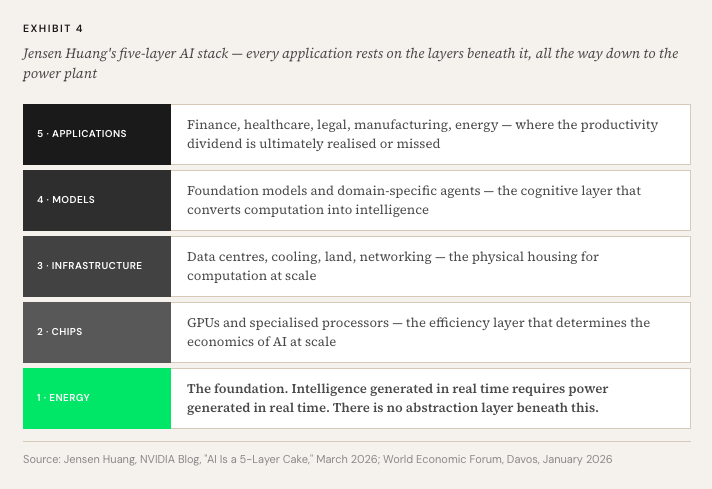
At Davos in January 2026, Jensen Huang made an observation that reframes the entire agentic AI story in terms of physical reality. AI, he argued, is not software in the conventional sense. It is infrastructure, the foundation, he said, of the largest infrastructure buildout in human history. His organising image was a five-layer cake: energy at the base, then chips, then physical infrastructure, then models, and at the top, applications. The directional logic was the point: every application rests on every layer beneath it, all the way to the power plant. There is no abstraction layer beneath energy.
At Joulen, we think about this as two megatrends that cannot be understood in isolation. The AGI transition and the energy transition are not parallel stories. They are the same story told from different ends. The intelligence being built runs on electrons. Every token generated, every inference drawn, every decision made by a long-horizon agent represents a conversion of energy into computation. Huang estimates that we are only a few hundred billion dollars into a buildout that will require trillions. The energy implications of that are the precondition for everything above them in the stack.
But the energy question is not only quantitative. The AI infrastructure buildout demands energy that is intelligent, power that can respond in real time to variable data centre loads, participate in grid balancing markets, and optimise continuously across distributed portfolios of generation and storage assets. The energy system needs to become, in its own way, as agentic as the applications it powers. At Joulen, we don’t view this as a future consideration but as the work of the present.
The Conclusion
Shortening the Lag
The pattern documented in Part II of this series, technology arriving decades before its productivity dividend because organisational redesign takes a generation, has recurred consistently enough to be treated as a structural feature of how economies absorb general-purpose technologies. It is not inevitable. But it is the default outcome in the absence of deliberate action.
What deliberate action looks like is, in the end, straightforward to describe even if it is hard to execute. It means taking Conway’s Law seriously: treating the organisational structure not as the backdrop to a technology deployment, but as the primary design decision. It means asking, for each function and each process, not “how do we use AI here?” but “what would this look like if we designed it today?” It means accepting that technology adoption and organisational redesign are not sequential problems, adopt first, redesign later, but a single problem that produces results only when solved together.
Solow’s paradox was resolved eventually — not by computing becoming more powerful, but by organisations that rebuilt themselves around what computing made possible. The late 1990s productivity surge did not come from better software. It came from a generation of managers who stopped treating computers as faster typewriters. The same resolution is available now, and on a potentially shorter timescale because the pattern is known, the historical evidence is clear, and the capability threshold has arguably now been crossed.
The belt-and-pulley systems are still running in most organisations. The question is who will be the first generation to scrap them.