
Written by
Joulen,
+ SHARE


Previously in this series
In Part I, we argued that Marc Andreessen’s software revolution transformed the boundary between organisations and the world, but left the interior of organisations largely unchanged. Conway’s Law helps explain why: the organisational structure is the mould into which technology is poured. Stagnant TFP records across a number of G20 countries since 2008 is the measurable cost of that unchanged interior. In this post, we look at why this pattern, technology arriving long before its productivity dividend is not new, and what history tells us about how it resolves.
The economic historian Paul David published a paper in 1990 in the American Economic Review that arguably should be required reading for anyone making decisions about AI adoption today. Its subject was electrification. Its argument was simple and, with the benefit of hindsight, correct, the productivity gains from electricity did not arrive when electric motors became available. They arrived roughly forty years later, when factories were redesigned around what electricity made possible. The technology and the productivity surge were separated by a generation.
David’s paper, “The Dynamo and the Computer” was, of course, also an argument about computing, which at the time of writing was producing exactly the pattern Solow had identified. His point was that Solow’s paradox was not a paradox at all. It was a recurrence. The same thing had happened with electricity, and for the same reason.
The Evidence
Steam, Electricity, Computing and the Same Mistake Each Time
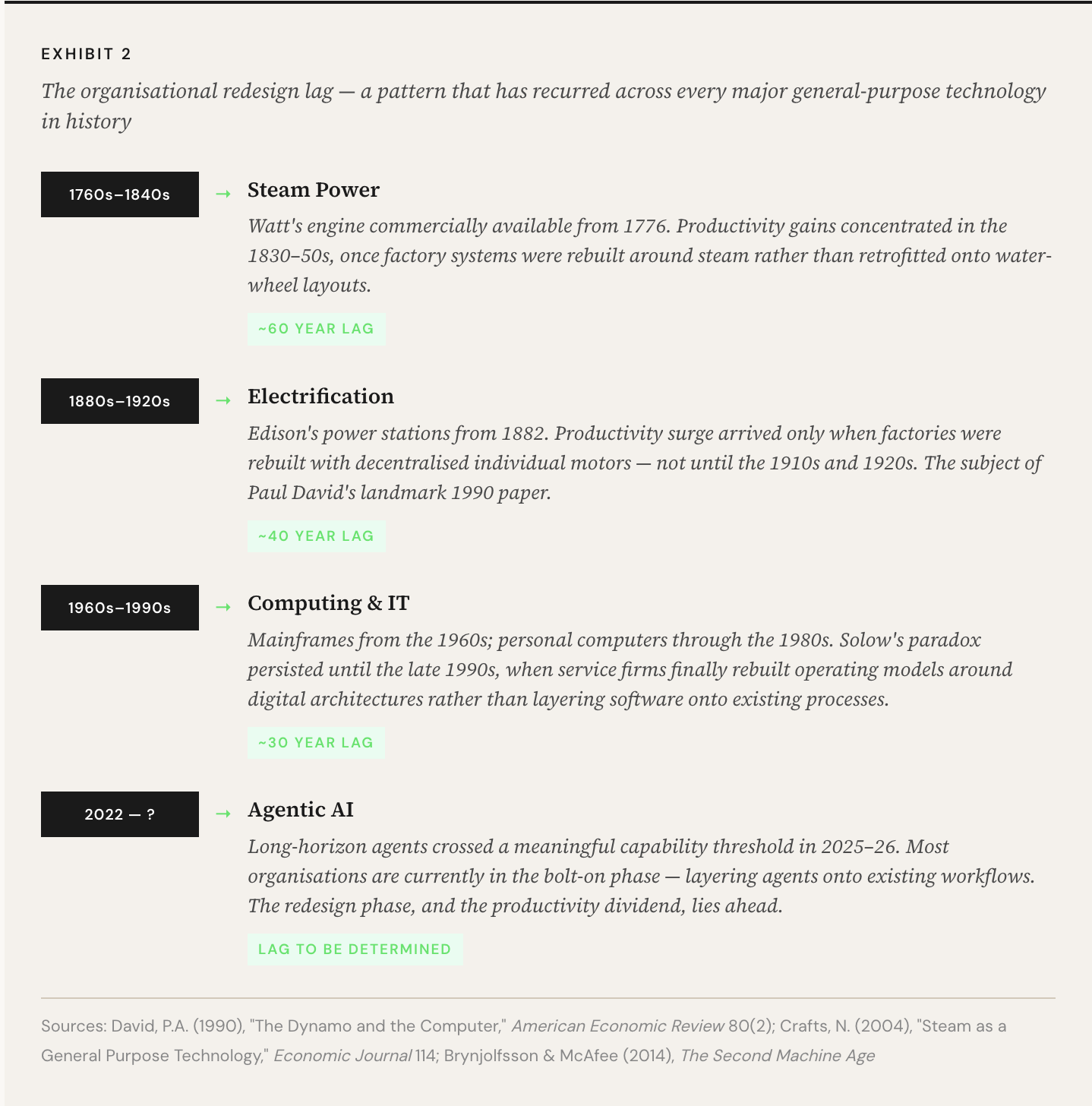
When electric motors became available to factory owners in the 1880s, most adopted them in the most natural way available, they replaced their existing central steam engines with electric motors driving the same belt-and-pulley transmission systems that had always existed. One power source for another. The layout of the factory floor stayed the same. The flow of work stayed the same. The hierarchy of the shopfloor stayed the same. And because everything stayed the same, the productivity improvements were modest, disappointing, even, relative to what the technology clearly seemed capable of.
The surge came when a new generation of plant managers, who had no intellectual or emotional attachment to the belt-and-pulley model, designed factories from scratch with individual electric motors at each workstation. Variable-speed operation became possible. Spatial layouts could be organised around the flow of work rather than the route of a transmission shaft. Entirely new production sequences became viable. The technology had been available for forty years. The organisational imagination to exploit it fully had taken that long to develop.
Steam told the same story over a longer arc. James Watt’s rotary engine was commercially available from 1776. The early mills and factories of the industrial revolution adopted steam quickly and, initially, in the same way. They bolted the new engines onto the same spatial arrangements and work patterns that had been designed for water wheels. The productivity revolution we associate with industrialisation, the step-change in output that transformed living standards, was concentrated in the 1830s and 1840s, not the 1780s and 1790s. Two generations of mill owners had to come and go before the redesign was complete.
Computing followed a compressed version of the same arc. Mainframes were deployed commercially from the 1960s, minicomputers through the 1970s, personal computers through the 1980s. Solow noticed the paradox in 1987. The late 1990s productivity surge, concentrated in the United States, arrived when a generation of managers who had grown up thinking digitally finally rebuilt service-sector firms around what computing made possible. Not faster versions of the old firms, but genuinely different ones. The lag from first commercial deployment to genuine productivity impact was around thirty years.
Exhibit 2
The Mechanism
Why the Lag Is Always Organisational
The pattern is clear enough. The more interesting question is why it recurs. Why does every generation of decision-makers, faced with a genuinely transformative technology, respond by bolting it onto existing structures rather than redesigning around it?
The answer is not irrationality. In each case, the bolt-on response was the rational one at the point of adoption. The technology was new and unproven at scale. The existing organisational arrangements represented enormous sunk investment, in physical layout, in workforce skills, in management practice, in embedded knowledge about how to run the operation. Replacing all of that simultaneously, on the basis of a technology whose full potential was not yet understood, would have been an act of genuine recklessness.
The redesign happened when a new generation arrived that had no investment in the old arrangements — people who had grown up with the technology and for whom the old mental models simply did not exist. The mill manager who had spent thirty years optimising a water-wheel layout could not fully imagine the factory that electricity made possible, because he had spent his career building the mental model of the factory that water wheels made necessary. His successor, who had never worked with water wheels, could.
This is the structural reason for the lag. It is not primarily about technology diffusion. It is about the time it takes for mental models (of how an organisation should be structured, how work should flow, how decisions should be made etc.) to change. And mental models change slowly, because they are embedded not just in individual thinking but in hiring practices, management training, organisational charts, incentive structures, and the accumulated culture of an industry.
The question this raises, which Part III in this series will attempt to address, is whether it is possible to deliberately shorten that lag. Whether, armed with the knowledge of this pattern, a generation of leaders can make the redesign conscious and deliberate rather than waiting for the generational turnover that has historically been required.
In the final post, we turn to the present moment, we will look at what Sequoia’s research in this area tells us about the threshold that has been crossed, what the redesign imperative actually means in practice, and why at Joulen we regard the energy transition and the AGI transition as the same challenge viewed from different ends.
+ SHARE
Latest Posts
Let's get Started
-Connect with an Expert