

Written by
Joulen,
+ SHARE


Following July’s Kaluza Breakfast Club in London, our Markets and Compliance Lead Jeremy Yapp reflects on whether the much-discussed “SaaS-pocalypse” really signals the end of software as a service or simply the beginning of its next phase. Drawing connections between SaaS, AI, customer relationships and the energy sector, Jeremy explores why domain expertise is becoming a more powerful differentiator than technology alone and considers how regulation specifically within energy must evolve to keep pace with rapidly changing technologies and business models.
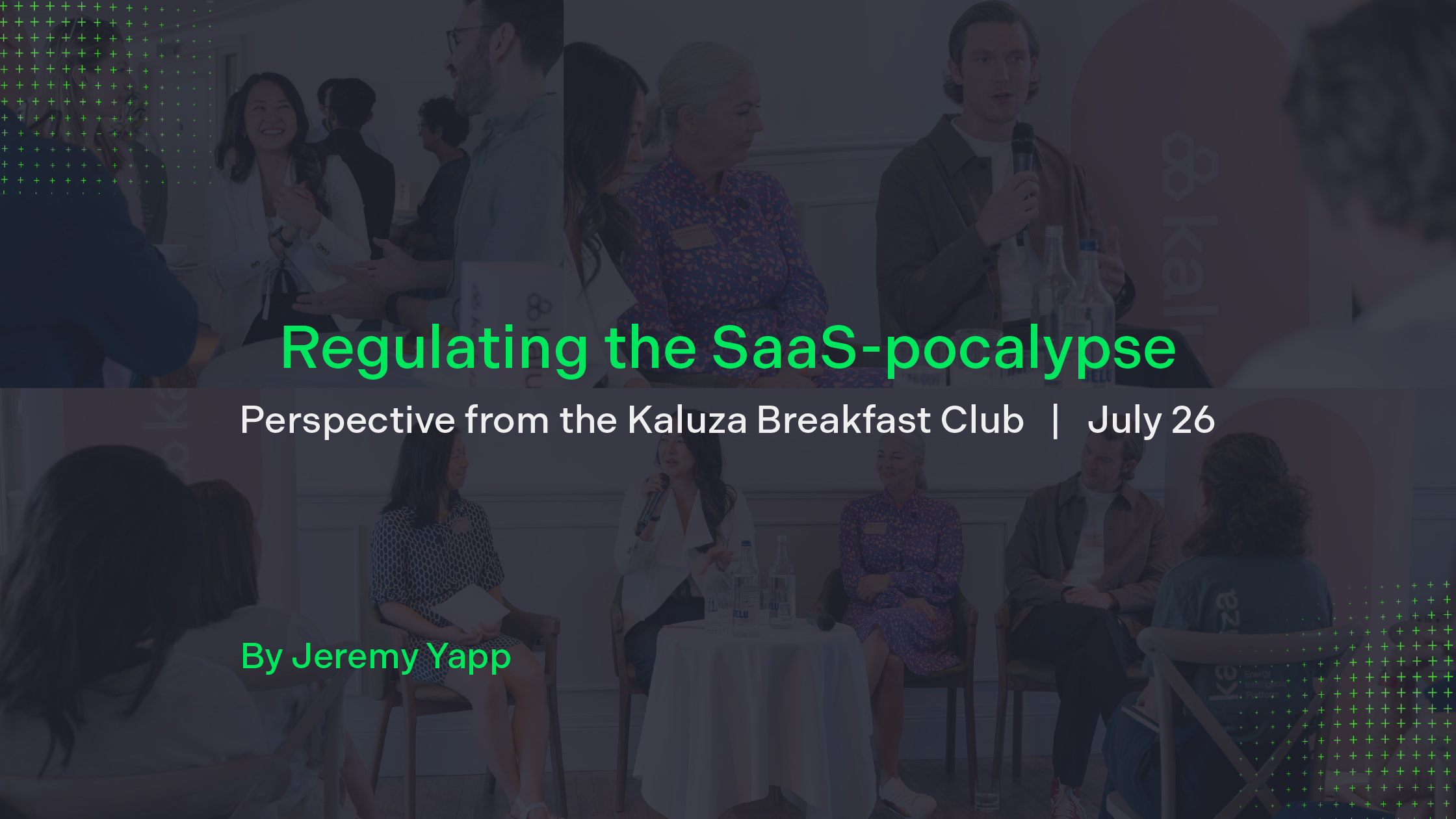
At this week’s Kaluza Breakfast Club, the topic for discussion was “Is it the end of SaaS? And if so, what comes next?”. The panel comprised software data and AI experts Paddy Morton from Anthropic, Anne-Marie Lamb from Salesforce and Carol Yan from AWS, all expertly moderated by Kaluza’s VP of Product, Barb Wong.
First a note on the arresting and irresistible phrase SaaS-pocalypse. Any report of the death of SaaS may indeed be an exaggeration: SaaS platforms remain important enablers of many core workplace functions, and they also provide support for advanced and innovative operations that smaller companies may prefer to buy rather than build.
The low initial setup costs, automatic feature enhancements, and flexibility of access remain compelling even as SaaS business models are evolving and diversifying. One member of the panel described this evolution as entering an era of uncertainty, not an era of decline or fear for future viability. It was acknowledged that having great tech is no longer a “moat” to protect you from your competition – you need more.
In particular, building apps and workflows is no longer a differentiator. The success of SaaS models is increasingly built on the core nontechnical differentiators such as the domain expertise and the customer relationship. SaaS enables the “vanilla integration” (not my phrase) between the licensing company and its customers, and then provides the security, data privacy, connectivity and functions that allow that relationship to bloom. There was a general agreement that the SaaS company should not be seeking to own the relationship with the end customer, but to enable its licensing company to deepen its relationships with its customer and to own more and more of the end-to-end process. For the licensing company that means diversification, which is both a pain-point and an opportunity: this “disintermediation” can be a competitive advantage, but it still runs into the question of whether to buy or build the functionality.
There followed a fascinating discussion of whether infrastructure ownership equates to operational ownership, and that topic might have to wait for another post all to itself; but it is interesting to apply that question to energy flexibility and load control. The UK government will make load control and the provision of flexibility services licensable activities from late next year, and this will raise some fascinating issues about how we nurture and support our end users (residential, commercial and industrial) on their journeys to becoming more active participants (prosumers, even) in the energy system.
In the meantime, the conversation moved on to questions of scale and competition. How and why do the SaaS giants work with smaller domain-specific emerging companies? The answer lies in domain-specific intelligence. There’s never been an easier time to be an entrepreneur, because the necessary AI tooling is available as never before. This articulates a vision of start-ups and scale-ups building on top of the SaaS platforms so long as those platforms provide interoperability and support for the smaller companies to be different, specific, agile and relevant. No one wants to be a commodity, so an emerging company needs a great deal of self-knowledge and awareness of where it is offering extra value to a customer. It also needs a clear strategy for how it wants to work with and use its platform: what motivates the SaaS provider as well as what motivates the end consumer.
Returning to my comfort zone, we finished with a fascinating exploration of the regulatory challenges. Here there are clear similarities to the challenges facing regulation of the energy sector. It is a truism that regulation moves too slowly to keep up with technology, but the example used, of a network operation preparing an ED3 proposal now, with tech that didn’t exist five years ago, was a clear illustration of the challenges. I am more convinced than ever that we policy experts serve the industry best when we are champions for regulatory change that keeps pace with technological developments – to “evangelize new tech”, as one panellist put it – but that also takes account of the uncertainties and is as future-proof as possible. The complexity of regulating an industry where fast-evolving technologies combine with emerging business models is what makes energy such a challenging and rewarding sector to work in.
Connect and continue the conversation with Jeremy Yapp
+ SHARE
Latest Posts
Let's get Started
-Connect with an Expert